Space kills everything.
- What Is a Tardigrade
- The Superpower Nobody Planned For
- The Temperatures It Should Not Survive
- The Radiation It Should Not Survive
- The Day They Actually Went to Space
- The Pressure It Should Not Survive
- The Chemicals That Should Have Killed Them
- 500 Million Years of Survival
- The Moon Has Tardigrades On It
- What Tardigrades Tell Us About Life
- The Smallest Tough Guy in the Universe
That is not hyperbole. It is physics. The vacuum of space exposes any living organism to a combination of conditions so hostile that survival is not just unlikely — it should be flat out impossible. There is no air. There is no pressure. Temperature swings from 250 degrees Fahrenheit in direct sunlight to negative 250 degrees in shadow. Cosmic radiation bombards anything not protected by a thick atmosphere or a carefully engineered spacecraft. Any liquid in an unprotected body instantly begins to vaporize. Any gas dissolved in blood and tissue expands catastrophically.
Humans in an unprotected vacuum would lose consciousness in about 15 seconds and be dead within two minutes. Most animals would fare no better. Even the hardiest bacteria struggle to survive the full combination of space conditions for any meaningful length of time.
And then there is the tardigrade.
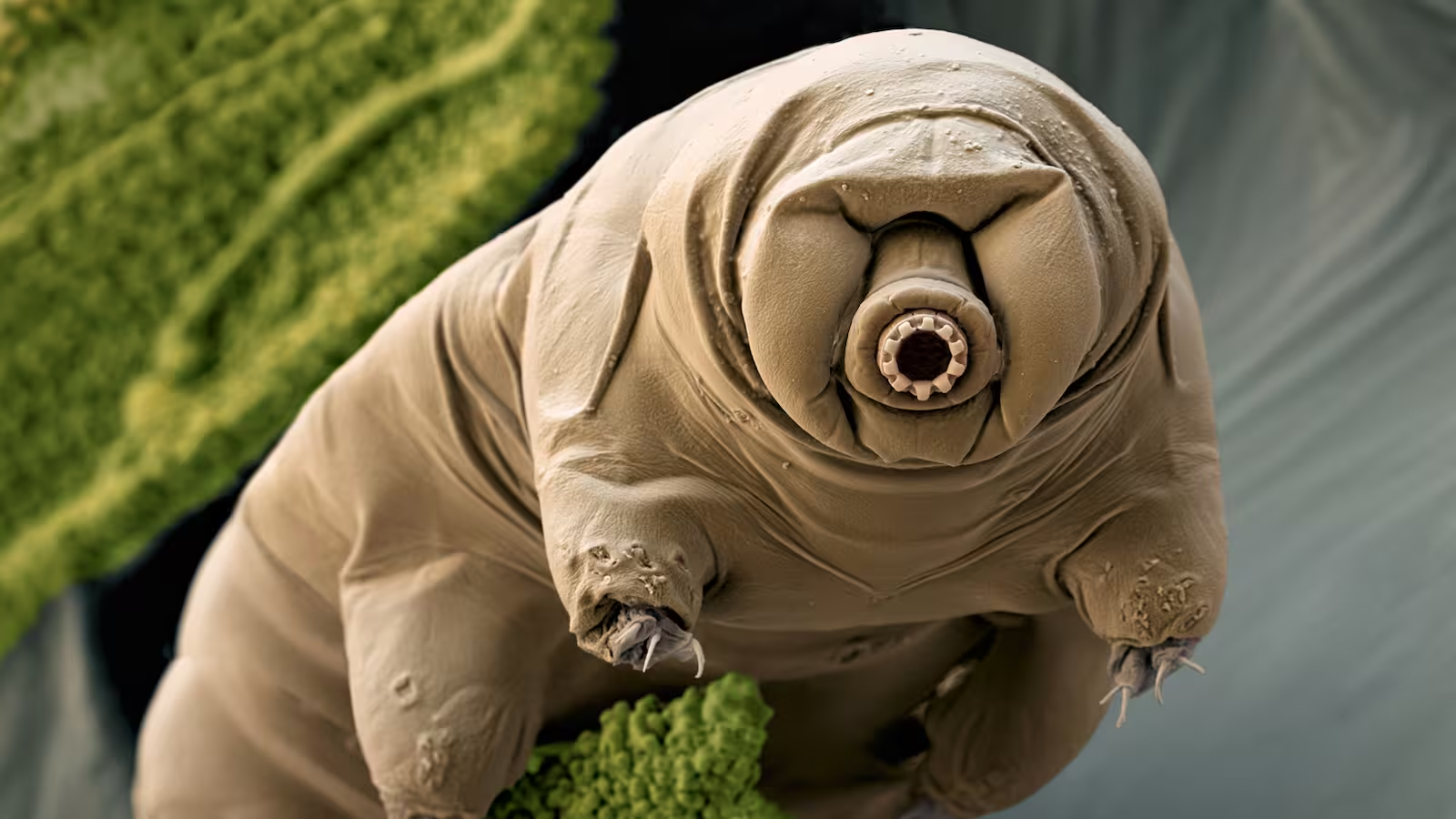
The tardigrade — also known as the water bear, or the moss piglet, depending on which nickname you prefer — is a microscopic animal approximately half a millimeter long that has been found living in the most extreme environments on Earth and has survived, in multiple experiments, direct exposure to the vacuum and radiation of outer space.
It should not be able to do this. Nothing should be able to do this. And yet here it is — an eight-legged, chubby, impossibly resilient little creature that has been roaming the Earth for over 500 million years and has survived every mass extinction event in the planet’s history, up to and including the one that killed the dinosaurs.
This is the story of the most indestructible animal on Earth. And possibly in the universe.
What Is a Tardigrade
Before getting into the extraordinary things tardigrades can survive, it is worth understanding what they actually are — because the answer is stranger than most people expect.
Tardigrades are animals. Not bacteria, not fungi, not some borderline case that scientists argue about. They are genuine multicellular animals with a body plan, organs, a nervous system, muscles, and a complete digestive tract. They eat. They reproduce. They move with a slow, lumbering gait that gave them the nickname water bear, because under a microscope they look remarkably like tiny bears walking through mud.
They were first described by a German pastor and zoologist named Johann August Ephraim Goeze in 1773, who called them kleiner Wasserbär — little water bear. The scientific name tardigrade comes from the Latin for slow walker, which is accurate. They are not fast. They do not need to be.
There are over 1,300 known species of tardigrades, found on every continent including Antarctica, in every habitat from the tops of the Himalayas to the depths of the ocean, from tropical rainforests to the frozen tundra. Wherever there is a thin film of water — on moss, on lichen, in soil, in leaf litter, in fresh water and marine sediment — there are almost certainly tardigrades.
They are everywhere. They have always been everywhere. And for most of their 500-million-year history, almost nobody noticed them.
The Superpower Nobody Planned For
The ability that makes tardigrades famous was not discovered by scientists searching for extremophile life. It was stumbled upon gradually, through a series of experiments that kept producing results that made no sense according to what scientists thought they knew about the limits of biology.
The key to the tardigrade’s survival is a process called cryptobiosis — a state of suspended animation so complete that the animal essentially stops being alive in any conventional sense while remaining perfectly capable of resuming life when conditions improve.
When a tardigrade encounters conditions that would kill almost any other animal — extreme desiccation, freezing temperatures, intense radiation, toxic chemicals, the vacuum of space — it does not fight the conditions or flee from them. It simply stops.
The process begins with the tardigrade pulling its legs and head inside its body, contracting into a tiny barrel shape called a tun. Then the extraordinary part happens. The animal expels almost all of the water from its body — reducing its water content from approximately 85 percent to less than 3 percent. Its metabolism drops to less than 0.01 percent of its normal rate. Its heart stops. Its brain activity essentially ceases. By any conventional measure, it is dead.
But it is not dead. It is waiting.
In this cryptobiotic state, a tardigrade can survive conditions that would obliterate virtually any other form of life on Earth. It can remain in this suspended state for decades — some researchers believe possibly for centuries, though the evidence for the longest claims is disputed — and then, when water becomes available again, it rehydrates, unfurls its legs, starts moving, and resumes its life as if nothing happened.
The metabolic pause is not just an interesting trick. It is one of the most remarkable biological mechanisms ever discovered — a complete, reversible shutdown of the processes we normally consider synonymous with being alive.
The Temperatures It Should Not Survive
Temperature is one of the most fundamental constraints on life. Biological molecules — proteins, DNA, cell membranes — function within relatively narrow temperature ranges. Too hot and the proteins denature, unfolding into useless tangles. Too cold and the water inside cells freezes, forming ice crystals that shred cellular structures from the inside.
These are not arbitrary limits. They reflect the underlying chemistry of life itself.
Tardigrades do not care.
In their cryptobiotic tun state, tardigrades have been cooled to minus 272 degrees Celsius — just one degree above absolute zero, the theoretical lowest temperature possible in the universe, the point at which all molecular motion essentially stops. They survived. They rehydrated and walked away.
They have been heated to 151 degrees Celsius — well above the boiling point of water, hot enough to cook most biological molecules beyond any hope of function. They survived that too.
The range of temperatures a tardigrade in cryptobiosis can endure is not just wider than any other animal. It essentially spans the entire range of temperatures that exist in the observable universe. From one degree above absolute zero to temperatures that would sterilize a laboratory instrument, the tardigrade sits in its little barrel and waits.
The mechanism behind this cold tolerance involves a suite of specialized proteins — including proteins unique to tardigrades that have no equivalent in any other known organism — that protect cellular structures from the damage that would otherwise be caused by ice crystal formation and the stresses of extreme cold. Scientists are studying these proteins intensively because understanding how they work could have profound implications for medicine, including the preservation of donor organs for transplant.
The Radiation It Should Not Survive
Radiation is the other great killer in space. High-energy particles and electromagnetic radiation damage DNA — breaking strands, scrambling the genetic code, creating mutations that either kill cells outright or turn them cancerous.
The amount of radiation that would kill a human being is about 5 to 10 Gray — a unit measuring absorbed radiation dose. Doses above that level cause radiation sickness, organ failure, and death.
Tardigrades can survive doses of up to 570,000 milligray — approximately 570 Gray — of X-ray radiation. That is roughly 57 times the lethal dose for a human being. In terms of ultraviolet radiation, their tolerance is similarly extraordinary — far beyond what should be survivable for any animal.
How do they do it? The answer involves several mechanisms working together.
Tardigrades repair DNA damage with extraordinary efficiency — their cellular machinery for identifying and fixing broken DNA strands is more active and more accurate than in almost any other organism. They also produce proteins called Dsup proteins — damage suppressor proteins — that physically wrap around the DNA molecule and shield it from radiation damage before it happens. These proteins are unique to tardigrades. Nothing else makes them.
When scientists took the gene for Dsup proteins and inserted it into human cells in laboratory conditions, those human cells showed significantly improved resistance to radiation damage. The tardigrade protein worked in human cells. The implications for cancer treatment, for protecting astronauts from cosmic radiation, and for radiation therapy are profound enough that multiple research groups around the world are now actively studying this single protein from a half-millimeter water bear.
The Day They Actually Went to Space
In 2007, the European Space Agency conducted an experiment called TARDIS — Tardigrades in Space — that sent tardigrades on a ten-day mission aboard the FOTON-M3 spacecraft in low Earth orbit.
The tardigrades were exposed to the full conditions of space. The vacuum. The temperature extremes. The cosmic radiation. The ultraviolet radiation from the sun, unfiltered by any atmosphere.
When they returned to Earth and were rehydrated, a significant portion of them were alive.
Some of the tardigrades exposed to the full combination of vacuum and cosmic radiation survived and recovered. A smaller but still remarkable number survived even the additional assault of direct solar ultraviolet radiation — arguably the harshest single condition in the experiment. Several of those survivors went on to reproduce normally, producing healthy offspring.
Nothing in the existing scientific understanding of biology should have allowed this. Exposure to the vacuum of space alone should have been lethal. The radiation should have destroyed their DNA beyond any possibility of repair. The temperature swings should have devastated their cellular structures.
Instead, they came home, drank some water, and went about their lives.
The experiment was repeated and confirmed in subsequent missions. Tardigrades are not just theoretically capable of surviving space conditions in laboratory simulations. They have actually survived space. In space. In the real vacuum of the real universe.
The Pressure It Should Not Survive
As if the temperature and radiation tolerance were not enough, tardigrades also hold records for pressure resistance that defy easy explanation.
Pressure is another fundamental constraint on biology. The pressure at the bottom of the Mariana Trench — the deepest point in the ocean — is approximately 1,086 atmospheres, roughly 1,086 times the air pressure at sea level. It is enough to crush most biological structures completely.
Tardigrades survive pressures of up to 75,000 atmospheres — nearly 70 times the pressure at the bottom of the Mariana Trench. This is higher than the pressure found anywhere in the natural environment on Earth. Scientists have had to build specialized equipment just to generate pressures high enough to test the limits of tardigrade survival.
They also survive in the vacuum at the opposite extreme — effectively zero pressure — as the space experiments demonstrated. The pressure range tardigrades can endure spans from essentially nothing to pressures that exist nowhere in the natural world.
The Chemicals That Should Have Killed Them
Tardigrades have also been found to survive exposure to environments saturated with carbon dioxide, hydrogen sulfide, and other toxic gases that would rapidly kill most animals. They survive immersion in organic solvents including ether and absolute alcohol. They survive exposure to brine concentrations far beyond what most cells can tolerate.
The chemical tolerance appears to be largely a function of the same cryptobiotic mechanisms that protect them against physical extremes. When the water is gone and the metabolism is essentially zero, there is very little for toxic chemicals to interact with. The cellular machinery is not running. The processes that toxic substances normally disrupt are not happening.
The tardigrade in cryptobiosis is in some ways less like a living organism and more like a very sophisticated set of biological instructions — stored in a form that is nearly impervious to the physical world, waiting for conditions that will allow the instructions to run again.
500 Million Years of Survival
The tardigrade’s extraordinary resilience is not a recent development. Fossil evidence — preserved in amber and in ancient rock formations — shows that tardigrades have existed essentially unchanged for at least 500 million years.
To put that in context. Five hundred million years ago, there were no fish. There were no land plants. There were no insects, no reptiles, no mammals, no birds. The ancestors of every vertebrate animal alive today were still swimming around in the ocean as simple, soft-bodied creatures.
Tardigrades were already there. Already doing what they do. Already surviving.
They survived the Ordovician extinction 440 million years ago, which killed approximately 85 percent of all species on Earth. They survived the Late Devonian extinction. They survived the Permian extinction — the most catastrophic mass extinction in the planet’s history, which eliminated approximately 96 percent of all marine species and 70 percent of all land vertebrate species. They survived the extinction that killed the dinosaurs.
Every time the Earth has gone through a catastrophic reset — asteroid impacts, volcanic eruptions covering continents, ice ages that buried most of the planet’s surface — the tardigrades were in their little tun states in the soil and the moss, waiting for it to be over.
They are still here. They will almost certainly outlast us.
The Moon Has Tardigrades On It
In April 2019, an Israeli spacecraft called Beresheet attempted to land on the moon. It did not go as planned. The spacecraft crashed into the lunar surface at high speed.
Among the cargo aboard Beresheet was a small container of dehydrated tardigrades, included as part of a project called the Arch Mission Foundation, which was attempting to create a library of Earth life deposited on the moon.
The container survived the crash. The dehydrated tardigrades — in their cryptobiotic tun state — almost certainly survived as well. They are sitting in the crash debris on the lunar surface right now, as you read this. Whether they could ever be rehydrated is a separate question — there is no liquid water on the moon to trigger their revival, and the radiation environment on the lunar surface is intense over long timescales. But the animals themselves are almost certainly still structurally intact.
The moon has tardigrades on it. We put them there by accident. It is one of the stranger footnotes in the history of space exploration.
What Tardigrades Tell Us About Life
The existence of tardigrades raises a question that goes well beyond biology.
If an animal can survive the vacuum of space, survive radiation doses that would kill a human being a hundred times over, survive temperatures spanning nearly the entire range possible in the universe, survive pressures found nowhere in nature — what does that tell us about where life might exist elsewhere?
The traditional view of habitable zones — the narrow band around a star where temperatures allow liquid water to exist on a planetary surface — is based largely on the limits of life as we understood them before we fully appreciated organisms like tardigrades. If life can survive in cryptobiotic form through conditions of almost unimaginable extremity, then the window for life to exist, travel between worlds, and persist through catastrophic events is dramatically wider than we assumed.
Some scientists have taken the tardigrade’s space survival as at least circumstantial support for the theory of panspermia — the hypothesis that life or the precursors of life can travel between planets or star systems aboard asteroids or comets, surviving the journey in a dormant state.
Tardigrades probably cannot travel between star systems — the timescales and radiation doses involved are likely beyond even their tolerance. But within a solar system, the possibility that microscopic life in a cryptobiotic state could survive transport on an asteroid from one planet to another is now taken seriously in ways it was not before.
The Smallest Tough Guy in the Universe
The tardigrade is half a millimeter long. It walks slowly. It eats algae and bacteria. It lives on moss. It has a face that looks, under a microscope, like a slightly confused vacuum cleaner.
It is also the most resilient animal ever discovered. It has survived for half a billion years through every catastrophe the Earth has thrown at it. It has survived actual outer space. It is sitting on the moon right now. Its proteins are being studied by cancer researchers and NASA engineers and molecular biologists who are trying to understand how something so small learned to be so indestructible.
The tardigrade did not develop its survival abilities for the benefit of human science. It developed them because life, given enough time and enough pressure, finds solutions that no engineer would have thought to design. The cryptobiotic state, the Dsup proteins, the DNA repair machinery — none of these were planned. They emerged over hundreds of millions of years of evolution in an animal that simply refused to stop existing.
That refusal — quiet, unconscious, molecular — is the most fundamental expression of what life does. It persists. It endures. It waits out the cold and the dark and the radiation and the crushing pressure, and when the water comes back it unfurls its legs and keeps walking.
Five hundred million years and counting.